%20(1).svg)
Home Workout vs. Gym: Can Home Training Really Replace the Gym?

Do you always need to go to the gym? Not necessarily. When comparing working out at home vs gym training, the best choice depends on your fitness goals, lifestyle, schedule, and personal preference. Whether you lift weights at home or at the gym, the same basic training principles apply. Your muscles do not know whether the resistance comes from an expensive gym machine or your own body weight. From a physiological perspective, a well-designed home workout can be just as effective as traditional gym workouts. Home workouts work particularly well for beginners and intermediate trainees, people with busy schedules, and anyone who wants to avoid commute time or the ongoing cost of a gym membership. Building maximal strength, however, requires heavy weights over the long term, so the gym eventually becomes essential for advanced trainees focused on maximal-strength development (Schoenfeld et al., 2017). Muscle mass, a firmer, more toned physique, and the other health benefits of training can also be developed very effectively at home.
Muscle growth, or hypertrophy, relies on the same physiological mechanisms regardless of where you train. When mechanical tension, training volume, and progressive overload are in place, home training can produce strong results. Current evidence shows that strength training with bodyweight can also build muscle and increase strength, provided you take your sets close enough to failure. In other words, the most important part is not the training location but whether the exercise provides enough resistance and progresses over time.
In this review, we cover the physiological principles behind an effective workout at home, smart exercise selection, the practical differences between a home gym and a gym environment, and how workout apps can automate progressive overload.
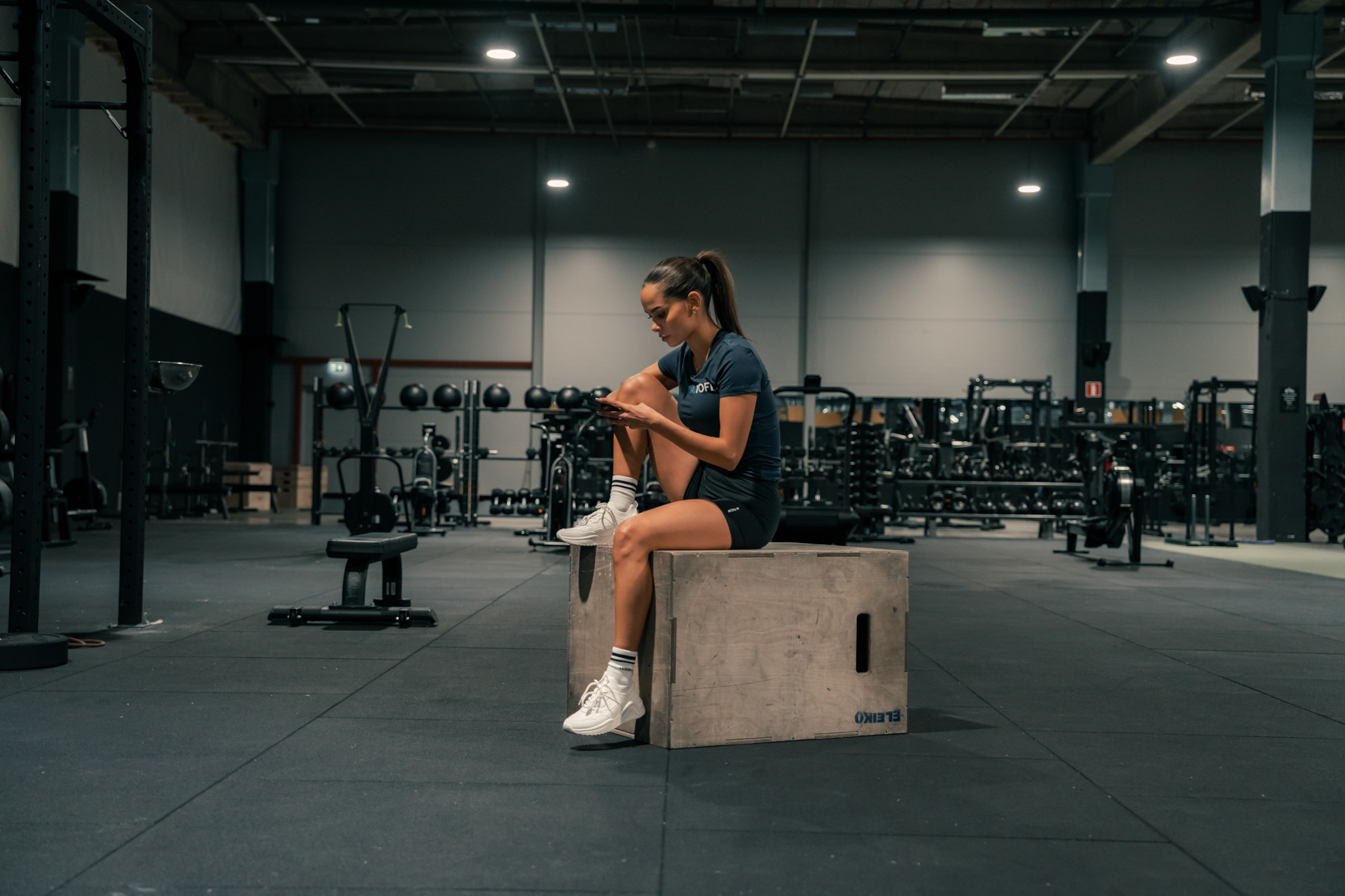
The physiology of muscle growth: why home training works without heavy weights
The main driver of muscle growth, mechanical loading, does not depend on where you train. You can create it effectively at home with squat variations, push ups, resistance bands, dumbbells, and other equipment, for example. Whatever resistance you use, focus on proper form and perform each rep with control, such as using a 2-second lowering phase. Deliberately slowing a movement too much can reduce force production (Schoenfeld, Ogborn & Krieger, 2015), so the better rule is to use a clean range of motion with a controlled lowering phase on each rep.
For muscle building, each set should be taken close enough to muscular fatigue. Relatively light resistance can be just as effective for hypertrophy as heavy weights, provided rep counts stay below roughly 35–40 and the sets are taken close to muscular failure (Schoenfeld et al., 2017). If the resistance is so light that you exceed 40 reps, cardiorespiratory or central nervous system fatigue may become limiting before the target muscle receives enough stimulus (Lasevicius et al., 2018). This also matters during fat loss, because resistance training helps preserve and potentially build muscle mass while losing fat.
The second key factor is volume, meaning the number of hard working sets you perform per muscle group each week. As a rule of thumb, aim for enough challenging sets to drive progress, typically 5–20 sets per muscle group per week. Beginners often make progress at the lower end of this volume range, while more experienced trainees usually need more volume to keep progressing. That total workload is entirely achievable at home, although managing it is often more practical at the gym (Schoenfeld, Ogborn & Krieger, 2017).
Effective home training and progressive overload
Working out at home without equipment can be both effective and practical, provided you have enough resistance and a clear progression strategy. The biggest challenge is usually maintaining progressive overload systematically. Without access to more equipment or heavier weights whenever you need them, you have to make exercises harder in other ways. This is where staying self motivated and following a clear plan matter, because it is easy to repeat the same routine without increasing the challenge.
Practical ways to make your home training more challenging:
-
Adding reps: Gradually increase the number of reps per set.
-
Adding sets: Increase your weekly volume by adding sets.
-
Harder exercise variations and unilateral movements: Switch to a mechanically harder variation, or progress from bilateral to unilateral movements.
-
Pauses: Use a variation with a deliberate 1–2-second pause at the hardest point in the range of motion. This removes momentum, or the so-called "bounce," and makes a light exercise harder without resorting to endless reps.
Home training with and without equipment: effects on hypertrophy and strength
Effective home training does not require gym machines. You can train without equipment by using your own body weight as resistance, so in principle all you need is your body, some room, and some time. Over the long term, though, training at the gym is often more practical because gym equipment makes progression easier and more straightforward. Most gyms also provide access to weight machines, free weights, heavy barbell lifts, and other equipment that make small increases in resistance easier to manage.
With a small investment in resistance bands, adjustable dumbbells, or a pull-up bar, you can add plenty of options to your home gym. Equipment lets you perform movements such as heavy horizontal rows and more targeted leg exercises, making progressive overload easier to maintain over time. The biggest benefit of the gym is simply access to more equipment. Many facilities also offer cardio equipment such as a treadmill, classes, personal trainers, and other amenities, although whether those features matter depends on your fitness goals. Home workouts can also save money if recurring membership fees are a concern.
How to build a well-programmed home workout plan
How many times a week you should train depends on the same basic factors whether you train at home or at the gym. For most people starting out, 2–3 workouts per week is often enough to get used to the training load. Over time, you can increase this to 3–4 workouts per week if you need more volume, but two sessions a week can already produce good results. An effective home workout can also be completed in as little as 30 minutes, which makes it easier to fit exercise around busy days. To keep every set high quality, build the session around the same basic components that any good workout program uses. The main workout can include squats, push ups, lunges, and crunches.
A simple, well-structured workout might look like this:
-
Warm-up: Warming up raises body temperature, improves muscle viscosity, and speeds nerve impulse transmission. You do not need the machine-based warm-up you might use at the gym, such as a rowing machine. Instead, use shoulder and hip rotations, jumps, or lighter versions of the exercises. On a busy day, a couple of lighter sets before your hard working sets can be enough to warm up properly.
-
Main exercises: 2–3 challenging compound movements that train your muscles in a well-rounded way.
-
Accessory exercises: 2–4 smaller, more targeted movements for areas such as your core or arms.
Your body needs rest days between workouts. Progress does not come from training alone; the adaptations happen during recovery. Rest days are therefore essential for progress. A simple, balanced week could include full-body workouts on Monday, Wednesday, and Friday, with walking, cardio, yoga, or complete rest on the other days. Another option is four weekly sessions using an upper/lower split. The best routine is ultimately the one you can stick to and fit around your lifestyle.
Home workouts: 5 common mistakes and how to fix them
Most home-training mistakes come down to poor programming or a lack of tracking. Done properly, home training can build strength and muscle, but random, occasional workouts are unlikely to produce lasting progress. Avoid these common mistakes:
1. Training that's too easy Training without traditional gym equipment can be effective, but the sets still need to be hard enough. At home, just as at the gym, you need to train close to failure. In the 6–15-rep range, a useful target is RIR 0–2, meaning you finish the set with only 0–2 reps left in reserve. When bodyweight sets extend beyond 15–20 reps, taking them to failure (RIR 0) is often the better approach. In long sets, much of the mechanical tension that muscle growth requires is generated during the final, uncomfortable reps (Morton et al., 2016). If you stop a long set too early, the training stimulus is substantially smaller.
2. A random program with no progression No matter where you train, you need a systematic plan with ongoing progression. For example, training volume and the load or difficulty of your exercises should increase and adapt to you from week to week. Training consistently matters more than making any single session especially long or exhausting. An occasional all-out workout cannot replace consistent programming. If motivation is lower at home, set a schedule and make it easy to stay focused and stay consistent from week to week.
3. Forgetting isolation exercises Heavy compound movements are the foundation of a program, but bodyweight sets can become very long and leave you breathless before the target muscle gives out. If you do, say, 30 bodyweight Bulgarian split squats, your heart and lungs may become the limiting factor before your quads do (Halperin et al., 2015). The solution is to include enough isolation work. Isolation exercises let you take the target muscle all the way to complete local muscular fatigue without cardiovascular fitness or balance becoming the limiting factor.
4. Weekly volume that's too low With bodyweight training, you may need slightly more sets than when using added resistance. To support progress, aim for 5–20 hard working sets per muscle group per week (Schoenfeld, Ogborn & Krieger, 2017). If the exercises feel too easy, adding reps or sets is one way to bring the weekly volume up.
5. A lack of progress tracking At the gym, it is easy to record the weights you lift, but tracking is often neglected at home. If you want to keep progressing, you need to know what you did the previous week and aim to improve gradually from one session to the next. This is where a workout app that automatically stores your training data can be useful. It removes the guesswork and helps keep exercise difficulty appropriate.
How AI is changing home workout programming in 2026
We have now covered the main science-based principles behind effective home training. Turning those principles into a program that fits you means managing several variables and adjusting them over time. Doing that manually takes time and expertise. In the past, this often meant working with trainers or personal trainers, but today some of the routine can be automated with technology.
A reliable AI workout app should be grounded in exercise science
In 2026, there are many AI-based workout apps on the market, and it helps to see how the best workout apps compare. Some make bold promises, and it can be difficult to tell which apps are genuinely trustworthy. The key is to look at the expertise behind the product. If the programming is based on research and developed by exercise scientists, you have a much stronger basis for judging its quality.
One option is the workout app AITOFIT, built on the same principles as an AI workout program grounded in exercise science and developed by a team of exercise scientists and AI professionals. A good AI workout app should handle the programming tasks covered above: calibrating the training load, adjusting difficulty, and updating the program as you progress. AITOFIT does this for gym training, home workouts, and outdoor gyms.
Summary: when is home training enough?
Beginners and intermediate trainees can build substantial muscle mass and strength with home training alone, provided mechanical tension, volume, and progressive overload are in place.
Advanced trainees can also maintain and develop their physique at home by using sufficiently challenging exercises and enough weekly volume. Over the long term, however, the gym offers better tools for maximal-strength development because it gives you easier access to heavier loads and specialized machines.
Keep these in mind:
-
Random workouts without a plan are not enough; you need progression.
-
Sufficient training volume matters for progress.
-
Make your bodyweight sets challenging enough. Leaving around 0–2 reps in reserve is fine.
-
Combine home training with outdoor gyms if you want more exercise variety.
Home training can therefore replace traditional gym training, provided the program is well designed and progress is tracked systematically. A hybrid approach can also work well if you enjoy home workouts on busy days but still want occasional access to heavier equipment at the gym. There is no need to worry about choosing one environment permanently. The better option is the one that fits your fitness goals and helps you train consistently. If you do not want to handle the programming yourself, professional guidance can make that process easier.
Try the AITOFIT app free for 9 days with no credit card, set your training environment to home workouts in the app settings, and see how evidence-based coaching works in practice.
Sources: Halperin et al. (2015), Threats to internal validity in exercise science: a review of overlooked confounding variables. Lasevicius et al. (2018), Effects of different intensities of resistance training with equated volume load on muscle strength and hypertrophy. Morton et al. (2016), Neither load nor systemic hormones determine resistance training-mediated hypertrophy or strength gains in resistance-trained young men. Schoenfeld et al. (2015), Effect of repetition duration during resistance training on muscle hypertrophy: a systematic review and meta-analysis. Schoenfeld et al. (2017), Dose-response relationship between weekly resistance training volume and increases in muscle mass: a systematic review and meta-analysis. Schoenfeld et al. (2017), Strength and Hypertrophy Adaptations Between Low- vs. High-Load Resistance Training: a systematic review and meta-analysis.
Author: Julius Granlund, M.Sc. in Exercise Science (Exercise Physiology), University of Jyväskylä | Reviewed by: Tapio Tulenheimo, M.Sc. in Exercise Science (Exercise Physiology), University of Jyväskylä
Individualized and evidence-based personal training made easily accessible to everyone.


