%20(1).svg)
Glute Workout: How to Actually Grow Your Glutes – Best Exercises, Program, and Training Guidelines

In Brief
The core of glute training is progressive loading through a long range of motion. Separate glute "activation" drills or warm-up exercises aren't necessary for muscle growth.
Combine different types of glute exercises. A good program includes, for example, an exercise that loads the glutes in a stretched position (deep squat, Romanian deadlift, Bulgarian split squat) along with a hip-extension movement like the hip thrust.
The squat and hip thrust grow the gluteus maximus roughly equally (Plotkin et al. 2023). However, adding the hip thrust to a program produced more glute growth than the same program without it (Kassiano et al. 2024).
Range of motion makes a big difference. Ten weeks of deep squats increased gluteus maximus volume by 6.7%, while half squats produced only 2.2% (Kubo et al. 2019).
For most people, roughly 5–20 hard sets per week is a good practical starting point for the glutes, split across two sessions, for example. Most sets can be done in the 6–15 rep range.
Home training can effectively build the glutes in beginners, as long as the training becomes progressively harder.
A realistic timeline: measurable changes within months.
This article covers what actually matters for growing the glute muscles, which exercises to choose at the gym and at home, and how much work it takes to achieve realistic results. It's written for both beginners and experienced trainees — anyone looking for optimal glute growth, a practical workout routine, and the best glute exercises. We'll also address common myths about glute training, such as glute activation.
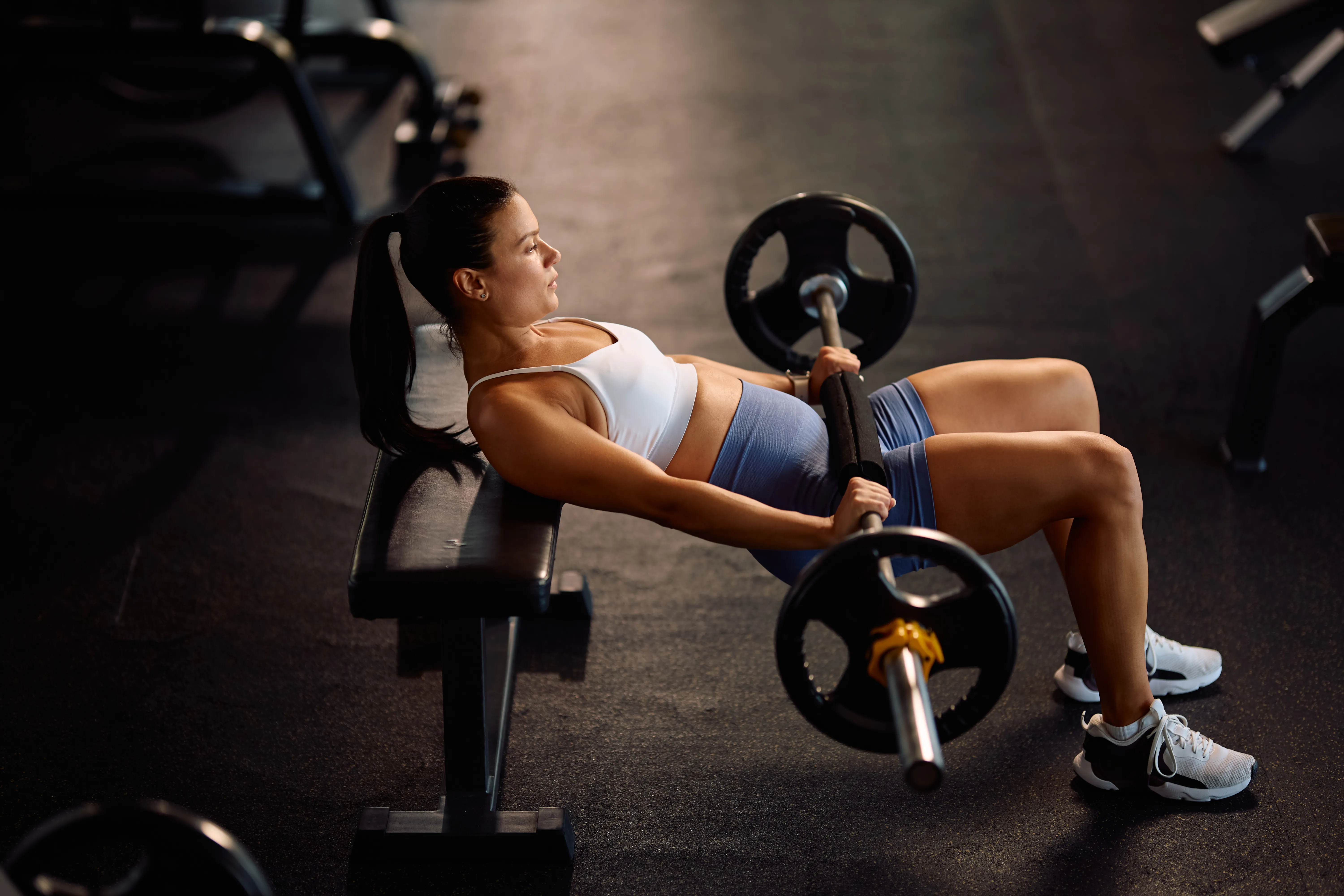
Which muscles does glute training actually grow?
The gluteus maximus accounts for the largest share of gluteal volume and is responsible for hip extension. The gluteus medius and gluteus minimus sit higher and more to the side, and they're responsible for hip abduction. Together, these three glute muscles contribute to lower-body strength and control.
The glutes aren't just one muscle. Although the gluteus maximus is the largest and strongest of the three gluteal muscles, the medius and minimus also play an important role in glute function and appearance.
The gluteus medius and gluteus minimus are beneath and to the side of the gluteus maximus. They abduct the hip — that is, take the leg out to the side — and contribute to hip stability by stabilizing the pelvis, especially when standing on one leg. This pelvic control is important during walking, running, and other single-leg tasks. They're smaller, but they contribute specifically to the fullness of the upper and outer gluteal region, helping to create a round, full shape.
It is also useful not to think of the gluteus maximus as one uniform area. Its different regions — upper, middle, and lower — seem to respond to training differently. In the MRI study by Plotkin's group, both the squat and the hip thrust produced the clearest glute growth in the lower portion, and the gluteus medius and minimus didn't grow with either exercise in any meaningful way.
This matters in practice: if you're only doing squats and hip thrusts and wondering why the upper part of your glute isn't filling out, the reason isn't that you're not trying hard enough.
Do the glutes actually grow from training — and by how much?
They do. Based on the research evidence, it is clear that resistance training can increase glute muscle mass and produce muscle hypertrophy. As with other muscles, the magnitude is somewhat more modest than glute-program marketing often implies: in ten-week studies, growth is typically a few percent, and it's highly individual. With a well-designed program, progress can be somewhat faster.
Let's look at what the research says. A 2025 systematic review and meta-analysis (Krause Neto et al.) pooled 12 studies and 318 participants and concluded that resistance training has a clear positive effect on gluteus maximus hypertrophy. Growth occurred with both single-joint exercises (hip thrust) and multi-joint exercises (squat, leg press), and with their combinations.
Here are some concrete numbers from several of the stronger studies:
Study | Duration | Intervention | Glute growth |
|---|---|---|---|
Kubo et al. 2019 | 10 wks | Deep squat (140° knee angle) | +6.7% volume |
Kubo et al. 2019 | 10 wks | Half squat (90° knee angle) | +2.2% volume |
Kassiano et al. 2024 | 10 wks | Leg press + stiff-leg deadlift | +6.0% thickness |
Kassiano et al. 2024 | 10 wks | Same + barbell hip thrust | +9.3% thickness |
Plotkin et al. 2023 | 9 wks | Squat or hip thrust | Similar growth with both |
These are results from 6–10-week interventions in untrained individuals performing one or two exercises. They aren't a prediction of where you'll end up after years of consistent training, and the total changes over that time can be much greater. They do, however, give a realistic sense of scale: the glute doesn't grow centimeters in weeks — it grows in percentages. Noticeable changes in size and roundness can come with quality training, but they take months to years.
Individual differences are substantial. Pelvic structure, fat distribution, and the glutes' growth potential are all strongly influenced by genetics. That means the best comparison is with your own starting point, not someone else.
Why glute "activation" isn't necessary
Short answer: you don't need to perform separate "activation" or "wake-up" exercises before training in order for the glutes to grow. Light bodyweight exercises or resistance band movements can work as a warm-up or technique practice, but muscle growth is driven by training that is sufficiently challenging and becomes progressively harder over time. A brief general warm-up — for example, around five minutes of easy cardio followed by dynamic movements such as leg swings — can also prepare the lower body for the working sets.
Feeling the glutes working strongly during training also isn't a prerequisite for an effective workout. A muscle can be loaded well even if you don't feel an intense burn in it. That's why it's better to judge a workout primarily by the exercise biomechanics, sound technique, sufficient loading, and long-term progression.
There's also no evidence that activation exercises improve glute function or growth. In Cochrane et al. (2017), for example, adding seven glute activation exercises to a training program for six weeks didn't improve glute muscle activity or hip extension strength compared with the same training without the activation component.
What matters most, then, isn't how strongly you feel the glutes during training, but how well the exercise loads the glutes and whether you can progress the training over time. Some people feel their glutes working strongly in squats, while others hardly feel them at all. Neither tells you, on its own, how effective the exercise is for muscle growth.
There's nothing wrong with activation exercises, though. If you enjoy them as a warm-up, go ahead. Glute kickbacks and other isolation exercises performed with resistance are different from light "activation" exercises: they can be useful glute exercises, as long as the resistance is sufficient and you can progressively increase the training demand over time.
What's the best exercise for the glutes?
In short: Some of the best glute exercises include Bulgarian split squats, deep back squats, Romanian deadlifts, hip thrusts, glute bridges, and step ups.
These exercises offer favorable resistance profiles for the glute muscles and can be loaded effectively and progressed over the long term. They also complement each other: some load the glutes more in a stretched position, while others emphasize loading closer to full hip extension.
Back squat vs hip thrust
There is a reasonable body of research comparing the back squat and hip thrust, but far less on other glute exercises. For growing the gluteus maximus, these two exercises are roughly on par. The squat also grows the quads and adductors; the hip thrust is more targeted. For most people, the most practical answer is to use both. A 2023 study by Plotkin's group provides a particularly direct comparison: 34 untrained individuals performed nine weeks of either back squats or hip thrusts, with set counts equated, and the results were measured with MRI.
The result: glute growth was the same in both groups across all measured regions. The squat group also experienced growth in the quadriceps on the front thigh and the adductors of the inner thighs; the hip-thrust group did not. The hamstrings didn't grow with either, which makes sense — contrary to what's often assumed, neither exercise loads the hamstrings significantly.
Bulgarian split squat vs back squat
No direct study has compared the Bulgarian split squat with the back squat for hypertrophy, but Arakawa et al. examined hip extension. The study found that the Bulgarian split squat produced a large hip-extension moment (Arakawa et al. 2023). From a biomechanical standpoint, the exercise is therefore a well-justified choice for glute training. This aligns with our observations: the Bulgarian split squat can place substantial load on the glutes and support glute growth. As a bonus, it lets you load the glutes without the heavy spinal loading of a back squat. A somewhat similar option is a front-foot-elevated lunge in a Smith machine.
There's no need to pit exercises against each other, though. In a study by Kassiano et al. (2024), 33 untrained women performed ten weeks of either the leg press and stiff-leg deadlift, or the same exercises plus the hip thrust. Glute thickness grew in both groups, but the group that added the hip thrust experienced greater growth: 9.3% versus 6.0%.
So rather than asking which exercise is better, the goal is to train the glutes through a well-rounded selection of movements. If I had to pick just one, I'd choose the Bulgarian split squat with a long range of motion.
Why do you need different exercises, and does it matter how they feel?
Different glute exercises load different parts of the glutes, so building strong glutes and adding muscle mass requires a combination of stretch-focused exercises, end-range hip-extension exercises, and abduction exercises.
Stretch-focused exercises — the squat, Bulgarian split squat, lunge, and Romanian deadlift place substantial load on the glutes with the hips flexed and the muscles lengthened.
End-range extension exercises — the hip thrust and glute kickback load the glutes relatively more near full hip extension.
Abduction exercises — for example the abduction machine and cable abduction load the gluteus medius and other gluteal regions involved in abduction more directly.
No single exercise loads the glutes effectively across their entire range of motion. That's why a glute workout should combine exercises from each of the three groups rather than relying on one movement alone.
Some exercises also feel better for some people than others. If squats don't feel right or you find the technique difficult to learn, you don't have to do them. Enjoying your training also matters, so individual preference should factor into exercise selection.
Why is the stretch phase of an exercise so important?
One important finding from recent muscle-growth research is that loading at lengthened muscle positions generally produces more growth than loading at shortened positions. This means that training through a long range of motion matters for growth.
Evidence specific to the glutes:
Kubo et al. 2019. In a ten-week back squat intervention, the deep-squat group (140° knee angle) increased gluteus maximus volume by 6.7%, while the half-squat group (90°) increased it by only 2.2%. In this study, relative glute growth in the deep-squat group was roughly three times that of the half-squat group.
Keep these points in mind when aiming for maximal glute growth:
Squat as deep as you can with control. A deeper squat can increase glute loading, but you don't need to force depth at the cost of good technique.
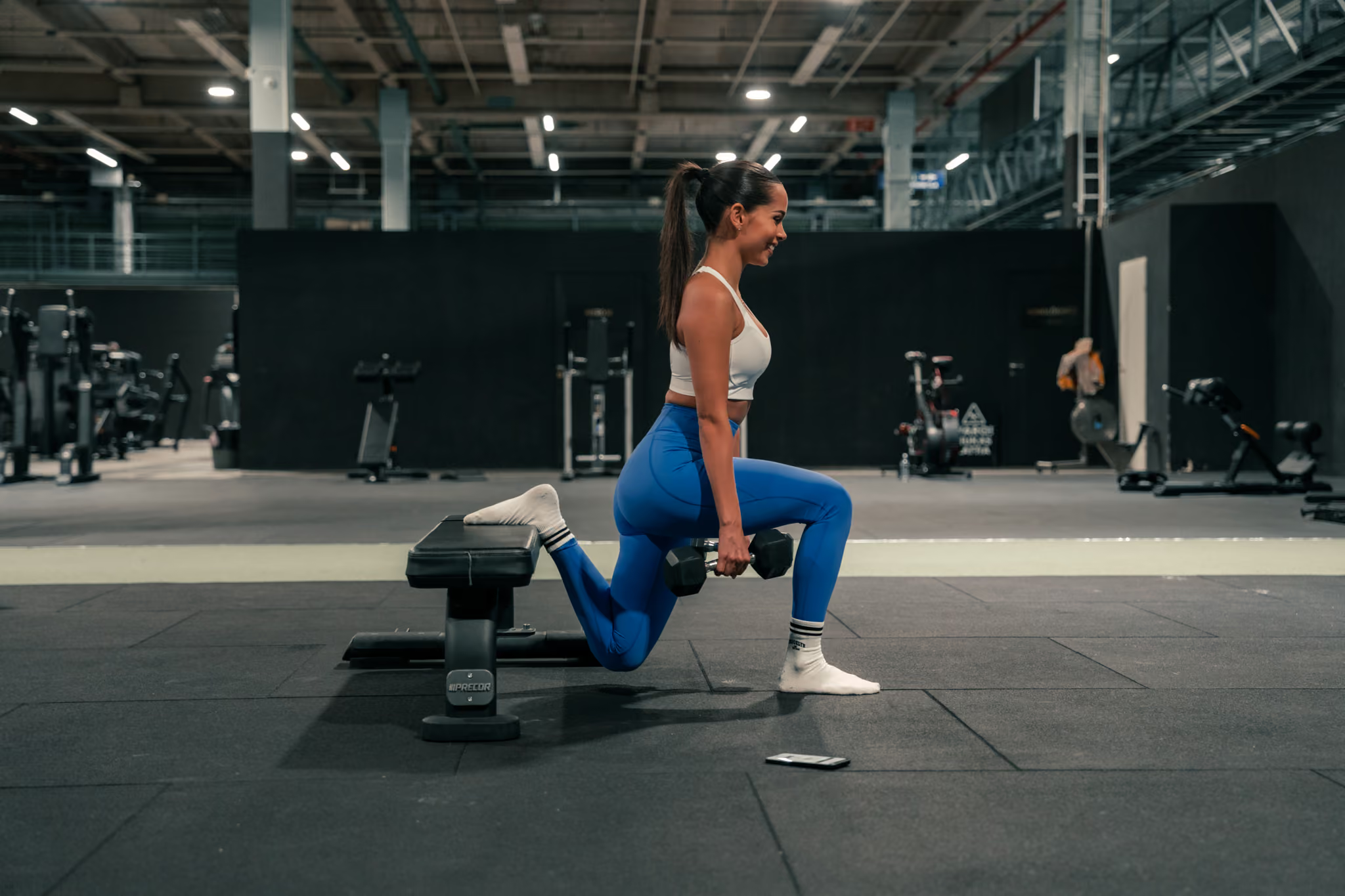
Try a longer stride in lunges. Put one foot forward far enough to increase hip flexion while keeping the front foot flat and the knee aligned with the toes. This allows you to load the glute in a more stretched position.
Use a controlled range of motion in the hip thrust. Keep your feet hip-width apart and flat on the floor, drive the hips forward to full extension without hyperextending the lower back, and slowly lower under control.
Why you shouldn't trust muscle-activation comparisons
Measuring muscle activation tells you how active a muscle is during a single set. It doesn't directly tell you how much mechanical load the muscle is experiencing, and it doesn't reliably predict how much the muscle will grow over time.
In Plotkin's study, both EMG activity and muscle growth were measured. The hip thrust produced a larger EMG signal in the glutes than the squat, but glute growth was the same between the groups. Many factors related to both the measurement and the movement can affect the EMG signal, so it isn't a direct predictor of how much a muscle will grow over the long term.
As a rule of thumb, when you see an exercise comparison, check whether it measured muscle growth or examined biomechanics, or merely measured muscle activity. If the latter, take the result with caution.
What does the best glute workout at the gym look like? Are single-leg exercises good?
Simply put: Build the workout around a squat pattern performed through a long range of motion, a hip-hinge movement, and one exercise that loads hip extension at end range. Single-leg exercises are a good way to address side-to-side imbalances, improve core stability, and shift the load toward the glutes rather than the quads. For a squat, a practical starting position is to stand with your feet shoulder-width apart, brace your core muscles, and lower into a controlled squat position while keeping the feet flat.
Here are effective glute exercises grouped by what they do. They aren't ranked, because a good program includes something from each group. Later, you'll also find practical suggestions for adding glute exercises to your gym program — for example, as part of a leg day.
Role | Exercises | Why |
|---|---|---|
Stretch loading | Deep back squat, Bulgarian split squat with a slight forward lean, walking lunge with a long stride, step-up, 45° back extension | Loads the glute at long muscle lengths; also trains the quads |
Hip hinge | Romanian deadlift, good morning | Strong stretch, easy to add load; also trains the hamstrings |
End-range extension | Barbell or machine hip thrusts, glute bridges, cable kickbacks, single-leg hip thrusts | Loads the portion of the range that the squat leaves out |
Abduction (upper glute) | Abduction machine, cable abduction, angled cable kickbacks | Loads the gluteus medius and minimus more directly |
A few notes:
Single-leg exercises are useful. They let you train each leg hard with a relatively low external load, they help address imbalances, and in Bulgarian split squats, for example, the glute can be loaded in deep hip flexion. A single-leg deadlift is another useful option when you want to challenge balance and glute control with less external load.
The leg press isn't the best glute exercise. It does load the glutes, but the hip moves through a relatively modest range of motion. It wouldn't be my first choice if the aim is to maximize the hypertrophy stimulus for the glutes.
In the hip thrust, use padding and a sturdy bench or a machine. Set your feet hip-width apart with both feet flat, keep each knee bent to roughly a 90-degree angle at the top, and brace the core muscles. Drive the hips forward until the torso and thighs form a straight line, squeeze the glutes for about a second, and slowly lower the weight under control. If you feel the exercise mainly in your hamstrings, move your heels closer to your glutes.
How do you train the upper and outer glutes — the gluteus medius?
Short answer: If you also want to emphasize the upper and outer part of the glutes, it's worth adding hip abductions to your program.
In Plotkin et al. (2023), neither the squat nor the hip thrust produced meaningful growth in the measured gluteus medius/minimus region. An anatomical analysis by Takahashi et al. (2025), meanwhile, shows that the abduction torque is concentrated primarily in the upper glute, while the extension and external-rotation torque is greatest in the lower portion.
So, if your goal is specifically to develop fullness in the upper and outer glute or to emphasize improving hip stability, it's worth adding abductions to your program and doing them with proper resistance. The gluteus medius and gluteus minimus are especially relevant to side-to-side pelvic control.
Effective home glute workout — does it actually work?
Short answer: Training without weights can work too, especially early in your training journey.
In Wei et al. (2023), both progressive bodyweight squat variations and barbell squats grew glute thickness in untrained women, with no significant difference between the groups over six weeks. The sample was very small (13 participants) and the training period short, so the result should not be overgeneralized. The study does, however, show that sufficiently challenging and progressive bodyweight training can grow the glutes — at least in untrained individuals.
The key word is progressive. Bodyweight exercises work as long as you can make the training gradually harder, which is entirely achievable for a beginner. As you progress, however, making bodyweight training harder becomes more difficult, especially for the legs. That's when external resistance and gym equipment make it considerably easier to keep increasing the load. For an at-home glute workout, useful options include glute bridges, single-leg glute bridges, reverse lunges, step-ups, donkey kicks, and other single-leg variations. You can read more about the differences between home and gym training here: Home workout vs the gym
You can make home training more progressive in four ways:
Move to harder single-leg exercises. This is one of the most effective ways to add load without weights, especially for leg training. You can progress from a regular squat to a Bulgarian split squat or a single-leg squat, and from a hip thrust to a single-leg hip thrust.
Add range of motion. Elevate the front foot in a lunge, or set up the hip thrust so the glute can stretch at the bottom of the movement. A larger range of motion and loading the muscle in a more stretched position can make the same exercise substantially harder.
Add reps or make the movement more challenging. If you can perform more reps than before, you've progressed. You can also make the movement harder by, for example, going deeper or pausing at the hardest point. Keep the weight the same, but make the exercise harder.
Add weight. A backpack full of books or water bottles, a kettlebell, dumbbells, ankle weights, or a strong resistance band can help considerably. The further you progress, the more important external loading becomes.
Note: with light loads, take sets close to failure. Light weights can produce comparable muscle growth to heavier loads when sets are taken hard enough (Schoenfeld et al. 2017). In practice, most sets can be stopped about 1–4 reps before failure. If athletic performance or cardiovascular endurance is also a goal, squat jumps or other plyometric movements can be added separately, but they aren't necessary for building glute muscle.
Example: at-home glute workout
Do the workout twice a week with at least one rest day between sessions. Take most sets to within about 1–4 reps of failure. The workout places a strong emphasis on the glutes, while the quads and hamstrings also receive some training stimulus.
Exercise | Sets × reps | Tip |
|---|---|---|
Bulgarian split squat, long stride | 2 × 8–12 / leg | Starting position: stand with your feet hip-width apart, place one foot behind you on a bench, and keep most of your weight on the front leg. Complete the set on your left leg, then switch legs and repeat on the right leg |
Single-leg hip thrust | 3 × 10–15 / leg | Shoulders on a bench or couch, feet flat and about hip-width apart; keep each knee bent, drive the hips forward, squeeze for a second at the top, then slowly lower |
Single-leg Romanian deadlift (kettlebell or backpack) | 3 × 10–12 / leg | From a standing position, shift your weight onto the left foot with a slight bend in the left knee, keep the other leg straight behind you and your arms straight, and maintain a neutral spine; then repeat with the right foot planted |
Walking lunge | 2 × 8–10 steps / leg | Step the right foot forward, keep the right knee aligned with the toes, then repeat with the left foot; keep the torso controlled and core muscles braced |
Side-lying banded abduction | 2 × 12–20 / leg | Use a strong resistance band and keep the working leg straight |
This home glute workout takes 30–40 minutes. Log your reps and try to improve from week to week: one more rep, a bit more resistance, or a harder exercise variation. That progressive overload is what allows bodyweight and weighted exercises to keep building muscle over time.
If you want a program individualized for you — for the gym, for home, or a combination — try the AITOFIT app.
How often and how much should you train the glutes?
Short answer: 5–20 working sets per week. Most training can be done in sets of about 6–15 reps, but lighter and heavier sets also build muscle. There's no single optimal set count for everyone. The right amount depends on factors such as training background, how hard the sets are, exercise selection, and recovery.
In our experience, most people need glute training volumes toward the higher end of this range. In many training programs, glute volume is already relatively high because the glutes are involved in so many exercises. This is one reason training volume can't be compared directly across different muscle groups. Based on the research evidence, an appropriate weekly set count for most people falls between 5 and 20 sets, but the exact amount should be individualized.
It's usually worth splitting the sets across at least two sessions per week. Not because there's something magical about two sessions, but because a larger weekly volume is usually more practical to distribute across several days. For more on training frequency, see: How often should you go to the gym?
Reps in practice:
1–6 reps: particularly well suited to developing strength.
6–12 reps: a practical range for the bulk of glute training aimed at muscle growth.
12–20 reps: work well for exercises like abductions and kickbacks, where heavy loading can be awkward.
For muscle growth, what matters more than the exact rep range is that the set is performed with sufficient effort and the overall volume is adequate. A good rule of thumb is to stop most working sets about 1–4 reps before failure. When you hit the target rep range with good technique, you can add load.
What about muscle soreness? It's a poor indicator of training effectiveness. Soreness is especially pronounced after new or unfamiliar training, and its severity doesn't reliably reflect the size of the growth stimulus (Schoenfeld & Contreras, 2013). You can make excellent progress without your glutes being sore the next day. In practice, the best metric is whether you can perform more reps or use more weight in the same exercises over time.
Glute workout for the gym, twice a week
These workouts can be used, for example, as part of a lower body or leg day — you can add hamstring and calf work as needed. They also work on their own if your goal is specifically to grow the glutes. Strong glutes contribute to hip extension, balance, and athletic performance, so the same movement patterns are useful beyond aesthetics alone.
Workout 1
Exercise | Sets × reps |
|---|---|
Deep back squat | 3 × 6–8 |
Barbell / machine hip thrust | 3 × 6–8 |
Cable kickbacks | 3 × 10–15 |
Workout 2
Exercise | Sets × reps |
|---|---|
Romanian deadlift | 4 × 6–8 |
Bulgarian split squat | 2 × 7–10 |
Abduction machine, slight forward lean | 3 × 10–15 |
9 sets per session for the glutes, 18 sets per week in total.
If you want to build glute training into a broader program, see our toning gym program for women, which integrates glute training into a full-body program.
The most common mistakes in glute training
1. No progression. Doing the same weights and reps month after month gives the body no reason to adapt. Keep your main exercises in the program long enough and aim to gradually add reps, load, or exercise difficulty. You don't need to swap exercises every few weeks.
2. Too many exercises. A few well-chosen, science-based exercises that allow you to track your progress will take you a long way.
3. The range of motion is too limited. The glutes are worth training in both lengthened and shortened positions. In squats and lunges, sufficient depth increases glute contribution, and in the hip thrust, take the movement to full hip extension under control without hyperextending the lower back.
4. The workout stays too light. The absence of a burn or a good "feel" in the glutes doesn't mean the muscle isn't working. What matters more is that technique remains sound and working sets are taken close enough to failure.
5. Training is one-sided. Doing only squats or only hip thrusts is not the best way to train the glutes comprehensively. Combine, for example, a squat or lunge movement, a hip-extension exercise, and a hip-abduction exercise. Reverse lunges, step-ups, and curtsy lunges are additional options, but you don't need every variation in the same workout routine.
6. Nutrition and recovery don't support the goal. Muscle growth is harder during a large energy deficit. Sufficient protein, sleep, and total energy support progress. A useful reference range is about 1.6–2.2 g of protein per kilogram of body weight. See: How much protein per day?
7. Expecting results too quickly. Muscle growth happens over months and years, not over individual weeks. Track your strength levels, measurements, and appearance over the longer term instead.
8. Knee position in the back squat. Gently pressing the knees outward during the movement makes the squat easier and allows the gluteus medius to stabilize the movement more effectively.
Frequently asked questions about glute training
How often should you train the glutes?
Training the glutes twice a week is a practical way to split the load. Weekly set count is usually more important than the number of sessions, and dividing the sets across two workouts makes it easier to accumulate enough volume while maintaining set quality.
How long does it take to grow the glutes?
Measurable muscle growth can be detected in studies within a few weeks or months. A visually noticeable change usually requires longer-term, consistent training, and larger changes are built over years.
Is the hip thrust mandatory for glutes?
No. However, it is an effective way to train the glutes. In Kassiano et al. (2024), adding the hip thrust to a program that already contained the leg press and stiff-leg deadlift led to greater glute growth than the program without it. The hip thrust can also be replaced with other exercises that load hip extension.
Can you train glutes at home without equipment?
At least for beginners, properly performed bodyweight training can go a long way when it is made progressively harder. In Wei et al. (2023), both progressive bodyweight squats and barbell squats grew glute thickness in untrained women, with no significant difference between the groups. When bodyweight no longer provides enough challenge, move to harder single-leg exercises or add resistance.
Do the glutes need to be activated before training?
No. This is a common myth, but it has no bearing on glute muscle growth. You also sometimes hear that "poorly innervated glutes require special activation." This is not supported by the research evidence.
Is the deadlift a good glute exercise?
Not really. Although the deadlift involves the entire posterior chain, including the glutes, the deadlift doesn't involve a long range of motion for the glutes, and there's usually no meaningful eccentric (lowering) loading. The Romanian deadlift is a considerably better choice for growing the glutes.
Why don't I feel my glutes during training?
A strong glute sensation isn't a prerequisite for effective training. How strongly you feel a muscle during a set doesn't necessarily reflect how effectively it is being loaded. Track your technique and whether you can add reps or load over time instead.
Should you squat deep for the glutes?
If your mobility and joints allow it, yes. In a ten-week study, deep squats grew the gluteus maximus volume by an average of 6.7%, while the half squat produced 2.2% (Kubo et al. 2019). So squat as deep as you can with good, controlled technique — you don't need to force maximum depth.
Summary
Effective glute training isn't complicated, even if social media might make it look that way.
Keep these points in mind:
Combine different types of glute exercises. A good program includes, for example, an exercise that loads the glute in a lengthened position (deep squat, lunge, RDL) along with a hip-extension exercise like the hip thrust.
Training has a clear effect on glute muscle growth. With consistent training, you will make progress. The gluteus maximus is also the body's single largest muscle.
Use a sufficient range of motion. In squats especially, a larger range of motion appears to benefit glute growth.
Progression matters more than the feeling of activation. Progressive overload means gradually adding weight or reps. What matters most is that training is challenging enough and progresses over time.
Home training can work well, as long as exercises stay challenging enough and the training is made progressively harder.
Think in months and years, not weeks. Muscle growth is slow, but consistent training compounds.
If you'd rather not calculate set volumes, choose exercises, and plan progression yourself, AITOFIT does it for you. Sport-science-based AI builds a program in which glute loading, exercise selection, and progression are tailored to your recovery and goals — and updates it automatically as you improve.
Sources: Arakawa H, Mori M & Tanimoto M (2023). Greater hip moments in rear-foot-elevated split squats than in conventional back squats with the same relative intensity of loads. Journal of Strength and Conditioning Research 37(5):1009–1016. Cochrane DJ, Harnett MC & Pinfold SC (2017). Does short-term gluteal activation enhance muscle performance? Research in Sports Medicine 25(2):156–165. Kassiano W et al. (2024). Addition of the barbell hip thrust elicits greater increases in gluteus maximus muscle thickness in untrained young women. International Journal of Strength and Conditioning 4(1):1–9. Krause Neto W, Krause TLV & Gama EF (2025). The impact of resistance training on gluteus maximus hypertrophy: a systematic review and meta-analysis. Frontiers in Physiology 16:1542334. Kubo K, Ikebukuro T & Yata H (2019). Effects of squat training with different depths on lower limb muscle volumes. European Journal of Applied Physiology 119(9):1933–1942. Plotkin DL et al. (2023). Hip thrust and back squat training elicit similar gluteus muscle hypertrophy and transfer similarly to the deadlift. Frontiers in Physiology 14:1279170. Schoenfeld BJ & Contreras B (2013). Is postexercise muscle soreness a valid indicator of muscular adaptations? Strength and Conditioning Journal 35(5):16–21. Schoenfeld BJ, Grgic J, Ogborn D & Krieger JW (2017). Strength and hypertrophy adaptations between low- vs. high-load resistance training: a systematic review and meta-analysis. Journal of Strength and Conditioning Research 31(12):3508–3523. Takahashi K, Kawama R & Wakahara T (2025). End-divergent architecture diversifies within-muscle mechanical action in human gluteus maximus in vivo. Journal of Biomechanics 179:112488. Wei W et al. (2023). Effects of progressive body-weight versus barbell back squat training on strength, hypertrophy and body fat among sedentary young women. Scientific Reports 13:13505. Background material: Juha Hulmi, Lihastohtori blog glute training article series (2012–2014).
Author: Julius Granlund, M.Sc Exercise Science (Exercise Physiology), University of Jyväskylä | Reviewed by: Tapio Tulenheimo, M.Sc Exercise Science (Exercise Physiology), University of Jyväskylä
Individualized and evidence-based personal training made easily accessible to everyone.


