%20(1).svg)
Shoulder Workout 2026 – How to Train Your Shoulders Based on the Research

An effective shoulder workout trains all three parts of the deltoid muscles: the front, side, and rear delts. For most people, 5–20 working sets per week is an optimal range. The best shoulder exercises include the barbell overhead press or dumbbell shoulder press, lateral raises with dumbbells or a cable machine, and rear-delt movements such as the reverse pec deck or face pull.
In this guide, we cover the following based on the research:
-
The best shoulder exercises
-
How many sets and reps to do
-
Whether to choose dumbbells or a cable
-
The most common mistakes in shoulder training
-
A sample program for muscle growth
Whether you're a beginner or an experienced lifter, this guide will help you build an effective shoulder workout routine for muscle growth and upper-body strength. Strong shoulders also make pressing and other upper-body training more capable and stable.
Contents
-
Which muscles are you actually training?
-
Is the overhead press enough?
-
The best shoulder exercises
-
Dumbbell or cable?
-
How many sets and reps?
-
The most common mistakes
-
Sample program
-
Frequently asked questions
Which shoulder muscles are the most important to train?
Short answer: For most people, the side and rear delts need the most attention and the strongest growth stimulus.
From a shoulder anatomy standpoint, the shoulder complex involves more than the deltoid alone. The major muscles most relevant here include the deltoid muscles and the rotator cuff. The deltoid has three distinct parts — the anterior deltoid, lateral deltoid, and posterior deltoid — while the rotator cuff is made up of four smaller muscles that help stabilize the shoulder joint. This makes the rotator cuff especially relevant to improving shoulder stability. Muscles of the upper back also control the shoulder blades. Because these structures have different roles, one exercise isn't enough to develop the whole shoulder. For shoulder health and injury prevention, balanced development may help reduce injury risk.
|
Part |
Main role at the shoulder joint |
Exercises that load it most |
Does it need isolation work? |
|---|---|---|---|
|
Front (anterior) |
Flexion of the shoulder joint and horizontal adduction |
Overhead press, bench press, dips, front raises |
Rarely |
|
Side (lateral) |
Abduction of the shoulder joint, with force output greatest at roughly 30–90° of abduction |
Lateral raise (dumbbell, cable, machine), upright row with elbows high |
Yes |
|
Rear (posterior) |
Extension of the shoulder joint and horizontal abduction |
Reverse pec deck, rear delt row, face pull, rowing movements |
Yes |
The main issue in many shoulder workouts is that the side and rear delts don't get enough direct work. If your program includes plenty of pressing, the front delt already gets a lot of load, while the side and especially the rear delt can fall behind. Balancing these different parts helps avoid obvious muscular imbalances.
Is the overhead press enough as shoulder training?
Short answer: Not on its own.
The overhead press is an excellent compound exercise for the front delt and also loads the side delt moderately. Both the barbell overhead press and dumbbell shoulder press are effective shoulder exercises for building shoulder strength. With dumbbells, a simple starting position is to stand with your feet shoulder-width apart, palms facing forward, and core engaged; press the dumbbells overhead until your arms are almost straight, then slowly lower them. The rear delt, on the other hand, gets little load from pressing, so overhead presses alone aren't enough to develop the whole shoulder.
Research reflects this as well. Campos et al. (2020) compared muscle activity (sEMG) across four exercises in resistance-trained men. The results were reported as a percentage of maximal voluntary isometric contraction (MVIC).
|
Exercise |
Front delt |
Side delt |
Rear delt |
|---|---|---|---|
|
Overhead press (barbell, seated) |
33.3% |
27.9% |
11.4% |
|
Lateral raise (dumbbell, seated) |
21.2% |
30.3% |
24.0% |
|
Bench press |
21.4% |
5.0% |
3.5% |
|
Dumbbell flye |
18.8% |
3.4% |
2.5% |
What can we conclude from the results?
-
Front delt: the overhead press produced the highest value among the exercises tested. If your program already includes overhead pressing and bench pressing, the front delt almost certainly gets enough stimulus without additional front raises.
-
Side delt: the overhead press and lateral raise did not differ significantly from each other. Both produced clearly higher values than the bench press and dumbbell flye.
-
Rear delt: the lateral raise produced the highest value, but you shouldn't conclude from this that the lateral raise is a good rear delt exercise. The study didn't test a single exercise based on horizontal abduction.
The limitations of EMG: why you shouldn't read this data at face value
EMG measures a muscle's electrical activity, not muscle growth or the mechanical load placed on the muscle. It therefore doesn't capture mechanical tension directly, even though mechanical tension is a key driver of muscle growth. EMG is, at best, an indirect measure. EMG studies can help inform exercise selection, but their findings should be interpreted alongside the broader body of evidence.
What are the best shoulder exercises?
Short answer: The best shoulder exercises depend on which part of the shoulder you want to develop. The overhead press is excellent for the front delt, lateral raises for the side delt, and the reverse pec deck or face pull for the rear delt.
A good shoulder exercise meets four criteria: it is stable, allows a long range of motion that suits the target muscle, is limited mainly by the target muscle rather than balance or grip strength, and can be progressively loaded. The key question is how well the exercise loads the target muscle through its range of motion. In practice, the best shoulder workouts combine compound pressing with isolation exercises rather than relying on a single movement. The shoulder strengthening exercises below cover the main movement patterns without making the workout unnecessarily complicated.
Some of the best shoulder exercises:
|
Exercise |
Main target |
Why is the exercise good? |
Typical sets × reps |
|---|---|---|---|
|
Barbell overhead press / dumbbell shoulder press |
Anterior deltoid, lateral deltoid |
Highest front-delt activity of the exercises tested; also loads the side delt. The resistance curve is less favorable for the side delt. |
2–4 × 7–10 |
|
Dumbbell lateral raise |
Lateral deltoid |
Direct shoulder abduction; shown to grow the side delt and biomechanically well suited to the muscle. |
2–4 × 8–20 |
|
Cable lateral raise |
Side |
Favorable resistance curve for the side delt, with tension through the full range of motion |
2–4 × 8–20 |
|
Machine lateral raise |
Side |
Stable and easy to control through the same range of motion as other lateral-raise variations. |
2–4 × 10–20 |
|
Reverse pec deck |
Posterior deltoid |
Highest rear-delt activity of the exercises measured |
2–4 × 10–20 |
|
Cable face pull |
Rear, side |
Horizontal abduction over a long range of motion |
3–4 × 12–20 |
To sum up, there's no single best shoulder exercise. Effective shoulder training includes, for example, the overhead press for the front delt, lateral raises for the side delt, and an isolation exercise for the rear delt.
Dumbbell or cable for lateral raises?
Short answer: For muscle growth, dumbbell and cable lateral raises appear equally effective based on the current evidence. Either is a valid choice.
A recent study (Larsen et al. 2025) compared the dumbbell and cable lateral raise in 24 experienced trainees.
The study in brief
-
24 trained men and women
-
An 8-week training period
-
2 sessions per week
-
10 working sets per week per arm
-
Rep range 12–16, sets taken to failure
-
Side delt growth measured by ultrasound
Results
Side delt muscle thickness grew by 3.3–4.6%, and no practically meaningful difference was seen between the dumbbell and cable lateral raise.
Conclusion: Both exercises grew the side delt equally effectively.
Why is the result interesting?
In this study, the dumbbell and cable lateral raise produced similar side-delt growth. That is notable because the cable variation is often assumed to be superior due to its more even resistance curve and greater loading at long muscle lengths.
The study still has a few limitations:
-
The study lasted only 8 weeks, so longer-term differences may not have had time to emerge.
-
Muscle growth was measured by ultrasound, and its measurement error was relatively large compared with the changes observed.
-
The cable lateral raise may have produced slightly greater growth at one measurement point, but the difference was not statistically significant.
Given these limitations, we can't say that either exercise is better for muscle growth.
Practical recommendation
If you prefer one variation, use it. Dumbbells are the simpler free-weights option, while the cable machine makes it easy to keep tension on the muscle throughout the movement.
If you want more variety, you can use both dumbbell and cable lateral raises, either on different training days or in different training blocks.

How many sets and reps should you do for shoulders?
Short answer
Working sets: for most people, 5–15 sets per week.
Frequency: train shoulders 2–3 times per week.
Reps: in most exercises, 7–15 reps. For lateral raises, 10–15 reps works well for most people.
Research shows a dose–response relationship between training volume and muscle growth. As the number of sets increases, muscle growth also tends to increase up to a point, after which the additional benefit diminishes (Pelland 2025). The optimal volume is therefore an individual range rather than a single number.
Recommendation for set counts: an optimal range is 5–20 working sets per muscle group per week (Schoenfeld 2017). For most people, 5–15 sets is a practical amount.
Frequency: a muscle group develops best when it's trained 2–3 times per week (Schoenfeld 2016, Baz-Valle 2022).
Rep ranges (the same as for other muscle groups):
-
1–6: strength-focused; use fewer reps mainly when strength is the priority
-
6–20: muscle growth
-
8–20: muscle growth in many isolation exercises (10–15 also works well)
On lateral raises, 10–15 reps is a practical range for most people. It is generally easy on the joints and makes it easier to keep technique consistent.
|
Experience level |
Working sets/week (e.g. side delt) |
Frequency |
Note |
|---|---|---|---|
|
Beginner |
5–10 |
2× |
Even a small volume is often enough |
|
Intermediate |
10–15 |
2–3× |
Worth splitting the volume across several sessions |
|
Advanced / priority muscle |
15–20 |
2–3× |
More careful attention to recovery |
Note that overhead-press sets can be counted toward the side delt as roughly half sets, because the movement doesn't direct all of its load to the side delt. Larsen et al. used the same approach when calculating training volume.
If you haven't chosen a training program yet, first read our guide on how many times a week you should go to the gym. After that you can look at, for example, a 3-day training program or start training with our app, individualized to you.
Technique: how do you do lateral raises correctly?
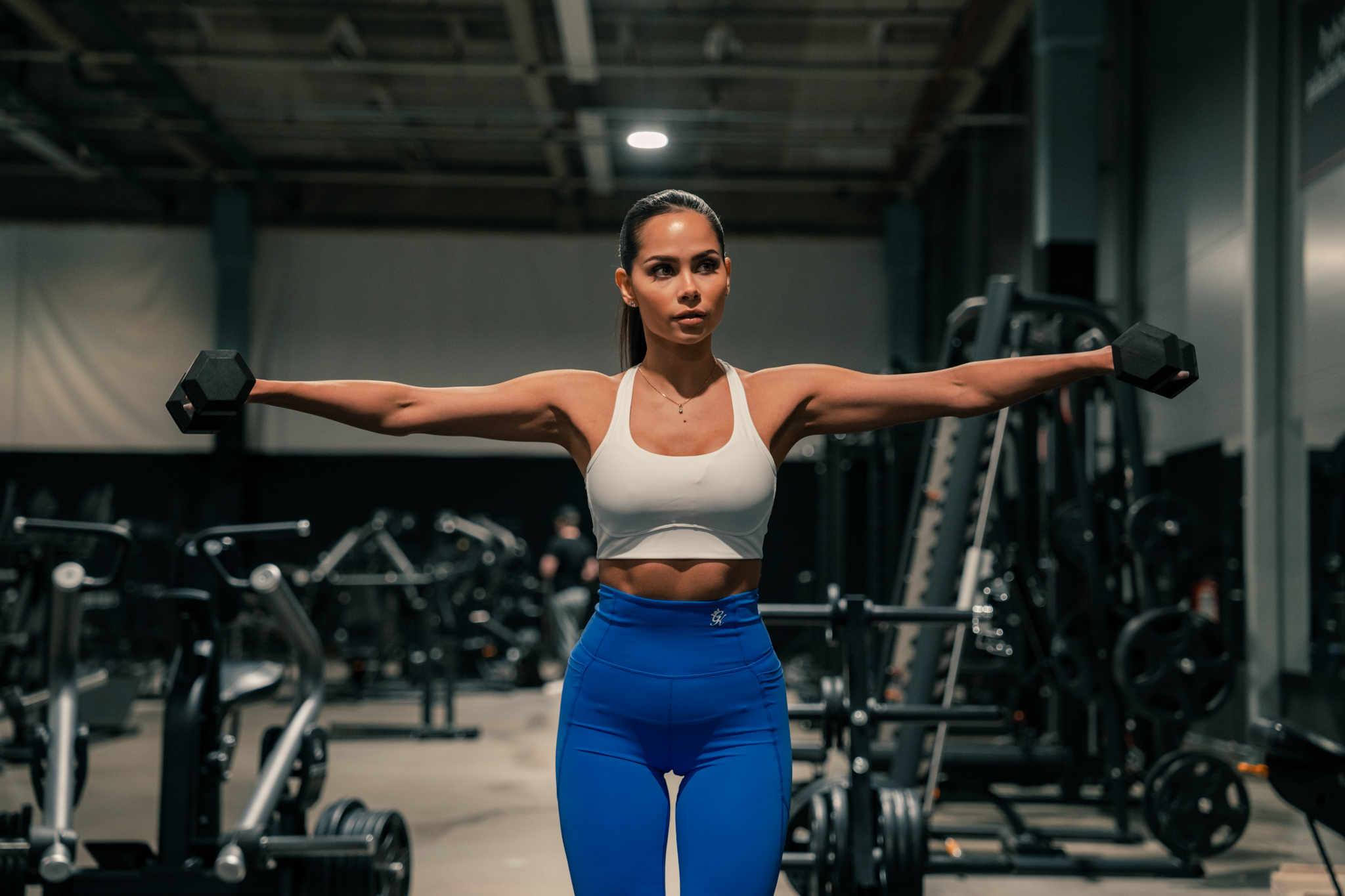
The lateral raise is one of the best dumbbell shoulder exercises for the lateral deltoid. For the starting position, stand with your feet hip-width apart, keep your knees slightly bent and your core engaged, and hold the dumbbells at arm's length with a slight bend in the elbows rather than locking your arms straight. From there, a few technique details make a real difference.
1. Arm path. The lateral deltoid works well when the upper arm moves slightly in front of the body with the palms facing slightly inward. A slight forward lean can make this arm path easier to maintain.
2. Lead with the elbow. Think about driving your elbows out to the sides, rather than simply moving the dumbbells upward. This cue often cleans up the movement immediately.
3. Lifting height. Raise your arms to roughly shoulder height. Going higher shifts more of the load toward the upper trapezius.
4. The tempo of the movement. Control both the lifting and lowering phases. A small amount of momentum near failure isn't a problem, but large swings reduce the load on the target muscle. A practical rule: keep the early reps strict, allow only a little assistance near the end of the set, and slowly lower the dumbbells for 2–3 seconds.
5. If your traps burn. The most common causes are lifting too high, shrugging, too heavy a weight, or raising the shoulders toward the ears. Lighten the weight and limit the lifting height to roughly shoulder level.
Why does the rear delt often stay underdeveloped?
Short answer: The rear delt is often neglected because typical pushing and rowing movements may not load it enough. It therefore usually benefits from dedicated isolation work, such as the reverse pec deck or face pull.
The rear delt, or posterior deltoid, primarily produces horizontal abduction, meaning it moves the arm backward and outward. This movement is relatively uncommon in typical gym programs. The rear delt contributes very little to pressing movements, and its involvement in rows depends heavily on elbow position and technique.
In practice this means it's worth setting aside dedicated sets for the rear delt, typically 4–10 working sets per week split across two sessions. The face pull and reverse pec deck are both effective options. Cable variations often allow a longer range of motion and more even tension than dumbbell versions, which can be useful when training the smaller muscles around the shoulder.
The four most common mistakes in shoulder training
Mistake 1: Shoulder volume isn't planned individually. Different people need different amounts of training volume.
Mistake 2: The rear delt doesn't get enough attention. This is one of the most common programming mistakes in shoulder training. Without enough horizontal-abduction work, the rear delt may not receive enough stimulus.
Mistake 3: The side delt doesn't get enough attention.
Mistake 4: The front delt gets too much attention. Typical training programs often place disproportionate emphasis on the front delt while giving the side delt too little direct work.
Example: shoulder workout as part of a weekly program
Below is a two-day shoulder workout template in which the side delt gets about 10.5 working sets per week and the rear delt 6 sets. The front delt also receives some work from the lateral raises. These set counts are only an example; the right amount depends on your total training volume and recovery.
|
Session |
Exercise |
Sets × reps |
Target |
|---|---|---|---|
|
Session A |
Dumbbell shoulder press |
3 × 8–10 |
Front, side |
|
Cable lateral raises (one arm at a time) |
3 × 12–16 |
Side |
|
|
Reverse pec deck |
3 × 12–16 |
Rear |
|
|
Session B |
Dumbbell lateral raises |
3 × 8–12 |
Side |
|
Machine lateral raise |
3 × 10–12 |
Side |
|
|
Cable face pull |
3 × 12–16 |
Rear |
Note:
The 3 overhead-press sets are counted toward the side delt as roughly half sets, bringing the side delt's weekly volume to about 10.5 sets.
How does AITOFIT program shoulder training for you?
The principles above are simple. The harder part is adjusting them over time, because the right set count, training frequency, and exercise selection don't stay fixed. They should change with your progress, recovery, total training volume, and life situation. If shoulders are a priority, the volume needs to be optimized accordingly.
AITOFIT handles this automatically:
-
Individual weekly volume for each muscle group, including the different parts of the shoulder.
-
Splitting the sets across sessions so no single session places too much work on one muscle group.
-
Exercise changes when appropriate, for example alternating between dumbbell and cable lateral raises to provide variation.
-
Automatic weight and rep targets for every set, with progression after each session.
-
Training load adjusted to your recovery, including after breaks or illness.
The app was built by exercise scientists at the University of Jyväskylä, and it uses its own research-based AI models instead of generic algorithms. Take a closer look at how the AI builds a gym program.
Try the AITOFIT app free for 9 days and see what shoulder-training volume the system calculates for you.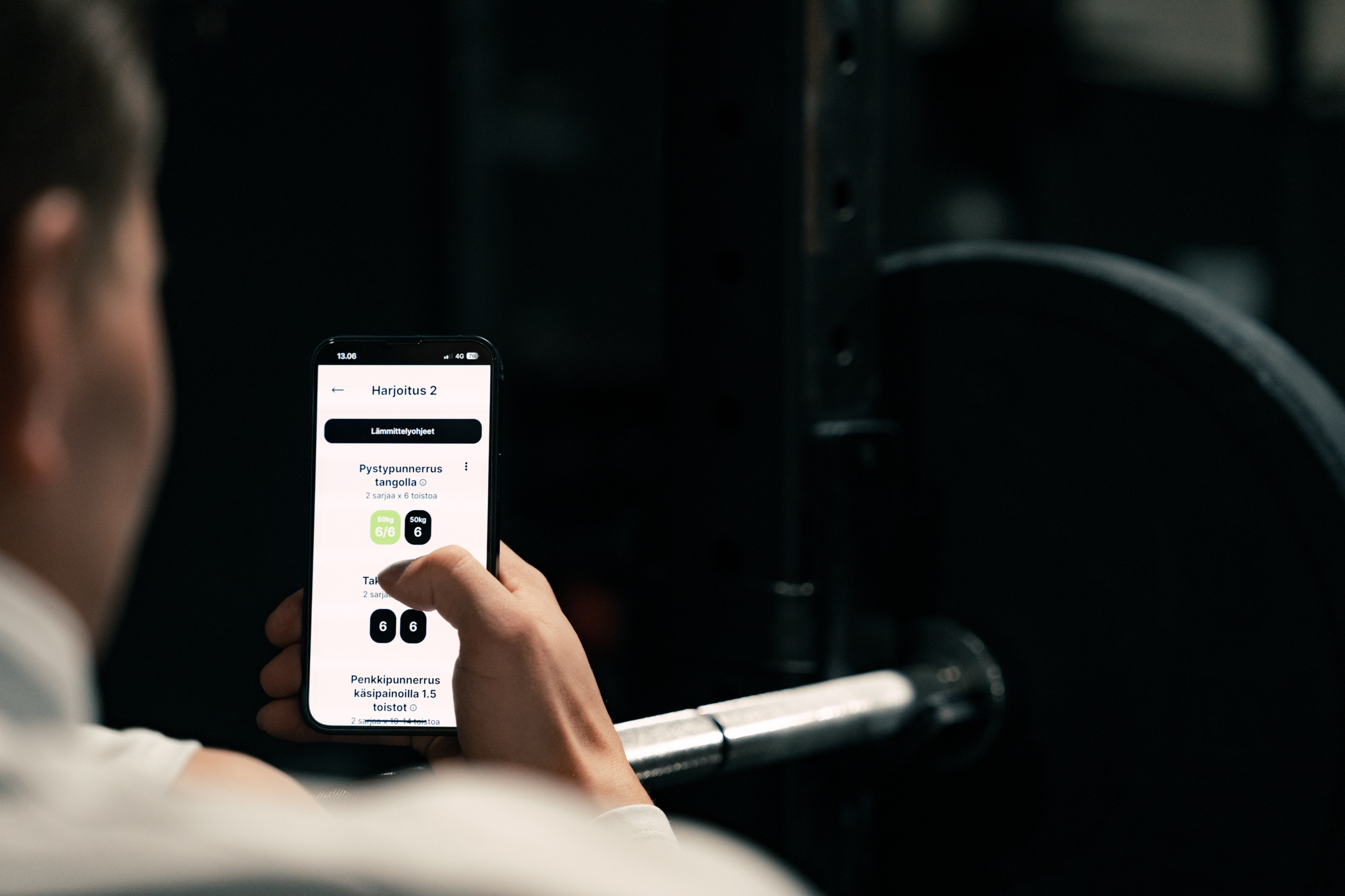
Frequently asked questions about shoulder training
How often should you train shoulders?
For most people, 2–3 times per week. This spreads the training volume across several sessions and helps maintain the quality of individual sets.
Is the overhead press enough as shoulder training?
No. The overhead press develops the front delt effectively and also loads the side delt moderately. It barely loads the rear delts at all.
Which is better, the dumbbell or cable lateral raise?
Either works. If you enjoy both, alternating between them is a reasonable option.
How many sets for shoulders per week?
For most people, 5–20 working sets per muscle group per week is an optimal range (Schoenfeld 2017), and 5–15 sets is enough for most trainees.
How high should you lift on the lateral raise?
Raise to about shoulder level. Going higher shifts more of the load toward the upper trapezius without adding much to the side delt.
Why do my traps burn on lateral raises?
The most common causes are lifting too high, shrugging, using too much weight, or letting the shoulders rise toward the ears. Lighten the load and think about driving your elbows out to the sides rather than lifting the weights upward.
Can you train shoulders at home without a cable?
Yes. Dumbbell exercises such as lateral raises and shoulder presses cover the front and side delts, while bent-over rear-delt raises or resistance-band raises can train the rear delt. The equipment matters less than taking your sets close enough to failure and increasing the challenge over time.
How long does it take to see results in shoulder growth?
In experienced trainees, 8 weeks of training with 10 weekly sets produced a 3.3–4.6% increase in side-delt muscle thickness (Larsen et al. 2025). Beginners may progress faster. A visible difference in the mirror usually takes several months of consistent, progressive training.
Summary
A good shoulder workout is based on a few simple principles:
-
Train all three parts of the shoulder. Overhead presses primarily develop the anterior deltoids, lateral raises target the lateral deltoid, and the reverse pec deck or face pull targets the posterior deltoid.
-
Do enough quality working sets. For most people, 5–15 working sets per muscle group per week is an optimal amount, split across 2–3 sessions.
-
Train progressively. Add reps or weight over time so the muscle continues to receive a progressively greater training stimulus.
Once these three basics are in place, smaller details — such as whether you do lateral raises with dumbbells or a cable — matter much less.
Your training program should evolve as you progress. Exercises, training volume, and load may need adjustment over time as your goals, performance, and recovery change.
Read also
Bench press technique, a step-by-step guide to the main pressing lift.
Do you want a ready-made shoulder workout?
AITOFIT builds a shoulder workout around your goals, selects research-based shoulder exercises, tracks your progression, and adjusts training volume as you improve.
Try AITOFIT free for 9 days and start a shoulder workout built around your goals today.This article is based on peer-reviewed research.
Sources: Campos et al. (2020). Different Shoulder Exercises Affect the Activation of Deltoid Portions in Resistance-Trained Individuals. Journal of Human Kinetics 75. Larsen et al. (2025). Dumbbell versus cable lateral raises for lateral deltoid hypertrophy: an experimental study. Frontiers in Physiology 16:1611468. Botton et al. (2013). Electromyographical analysis of the deltoid between different strength training exercises. Medicina Sportiva 17(2). Franke et al. (2015). Analysis of anterior, middle and posterior deltoid activation during single and multijoint exercises. J Sports Med Phys Fitness 55(7–8). Wolf et al. (2024). Lengthened partial repetitions elicit similar muscular adaptations as a full range of motion during resistance training in trained individuals. PeerJ 13:e18904. Schoenfeld et al. (2016); Baz-Valle et al. (2022) – training frequency and muscle growth. Schoenfeld, Ogborn & Krieger (2017); Pelland et al. (2025) – the dose–response relationship of training volume.
Author: Julius Granlund, M.Sc Exercise Science (Exercise Physiology), University of Jyväskylä | Reviewed by: Tapio Tulenheimo, M.Sc Exercise Science (Exercise Physiology), University of Jyväskylä
Individualized and evidence-based personal training made easily accessible to everyone.


