%20(1).svg)
Leg Workout 2026 – Best Leg Exercises and Complete Programs for the Gym and Home

Most leg workout guides are built on the same assumption: do enough squats and all your lower body muscles will grow. Recent imaging studies and biomechanical analyses paint a different picture – the hamstrings, for example, show little to no growth from squatting alone. In this article, I'll break down what research directly measuring muscle growth says about leg exercise selection and the best leg exercises, then give you complete leg workout routines for both the gym and home.
Key Takeaways
-
An effective leg workout typically includes 4–6 well-chosen exercises: for example, a squat or leg press, a Romanian deadlift, a leg curl, a leg extension, and a calf raise.
-
Squats alone aren't enough: the rectus femoris and hamstrings didn't grow at all from squat training in a 10-week study (Kubo et al. 2019).
-
For muscle growth, do most sets in the 6–15 rep range. Take your sets close to failure: leaving 1–3 reps in reserve is enough.
-
A practical target is 5–20 sets per muscle group per week, and the ideal amount is highly individual.
-
Train legs 1–3 times per week, with twice per week being a solid default. Total weekly volume matters more than training frequency, and higher volumes are usually best spread across multiple sessions.
-
Home leg workouts can build muscle as long as the exercises are challenging enough and you progressively make them harder over time. Single-leg exercises are especially useful for this.
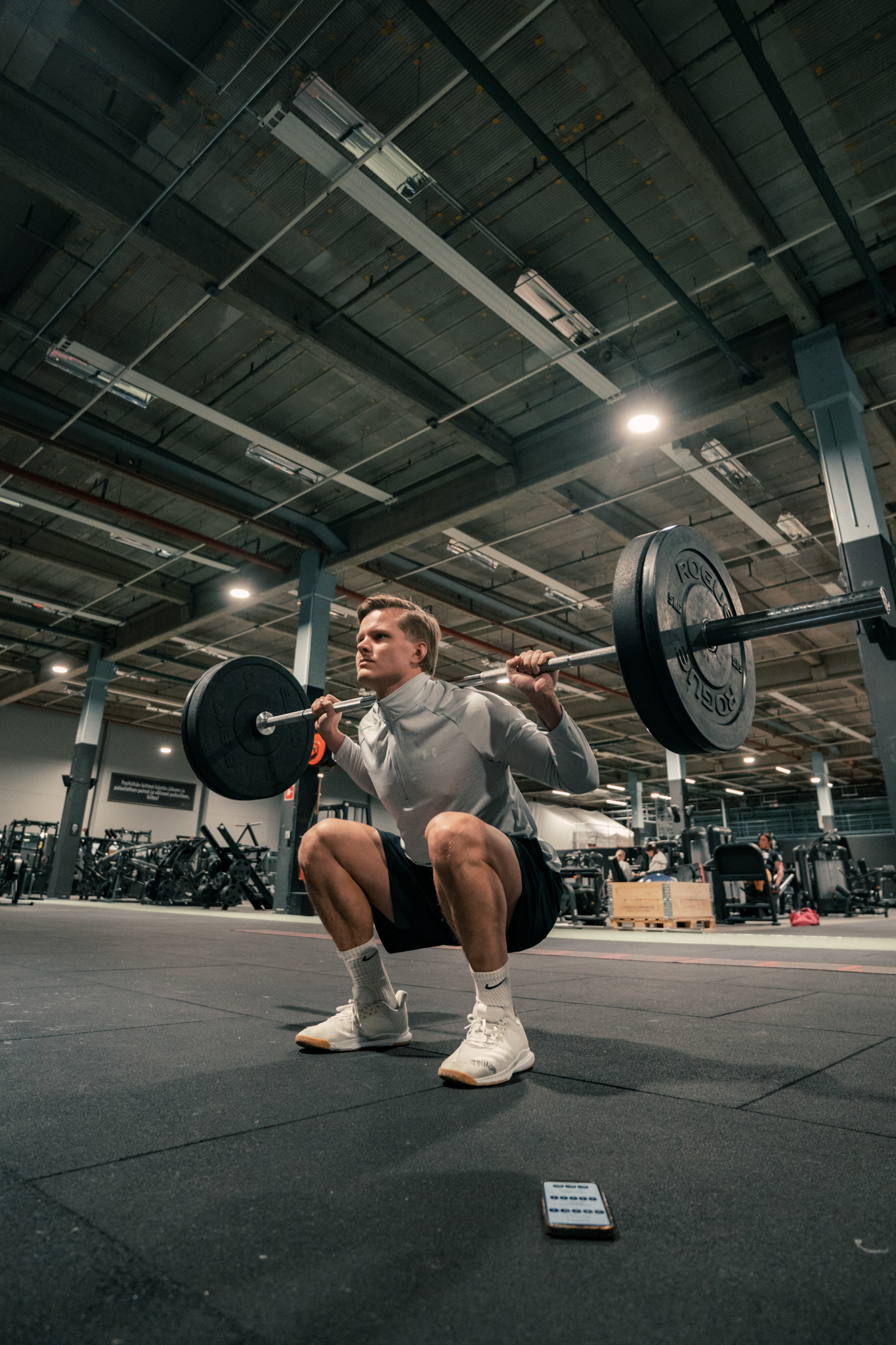
What Muscles Does a Leg Workout Train?
Short answer: A leg workout trains the quadriceps, hamstrings, glutes, adductors, and calf muscles. These major leg muscles perform different roles, and no single exercise effectively targets all of these muscle groups. A good lower body workout should therefore include several different movements.
|
Muscle Group |
Primary Function |
Effective Exercises |
|---|---|---|
|
Vasti (3 heads of the quadriceps) |
Knee extension |
Squats, leg press, leg extension |
|
Rectus femoris |
Knee extension + hip flexion |
Leg extension |
|
Hamstrings |
Hip extension + knee flexion |
Romanian deadlift + seated leg curl |
|
Glutes |
Hip extension |
Deep squat, Bulgarian split squat with forward lean, hip thrust |
|
Adductor magnus |
Hip extension in deep hip flexion |
Deep squat, leg press |
|
Calves |
Ankle plantarflexion |
Standing calf raise |
Anatomy explains why different leg exercises complement each other. For example, one of the four heads of the quadriceps – the rectus femoris – crosses both the knee and the hip. The other three heads (vastus lateralis, medialis, and intermedius) only cross the knee. That's why squats and leg extensions load different parts of the quads differently.
In the hamstrings, nearly every muscle crosses both the hip and the knee. These muscles contribute to both hip extension and knee flexion and form an important part of the posterior chain. This is why the Romanian deadlift and leg curl complement each other: the first loads the hamstrings through hip extension, while the second loads them through knee flexion.
The adductor magnus on the inner thigh is one of the largest muscles in the leg and contributes powerfully to hip extension, especially when the hip is in deep flexion. This is why deep squats also load the adductors well, even though they're not usually thought of as squat muscles.
In the calves, the gastrocnemius crosses the knee, while the soleus does not. This difference matters when choosing a calf raise variation – more on that below.
Why Squats Alone Aren't Enough
Short answer: Squats effectively grow the vasti muscles of the quads, the glutes, and the adductors, but the rectus femoris and hamstrings don't grow well – if at all – from squatting.
In a study by Kubo et al. (2019), men squatted for ten weeks using either a full squat or half squat, and muscle volumes were measured with MRI. The full-squat group increased quadriceps volume by 4.9%, glute volume by 6.7%, and adductor volume by 6.2%. The half-squat group saw gains of 4.6%, 2.2%, and 2.7%, respectively. However, the rectus femoris and hamstrings didn't grow in either group.
The reason comes down to muscle anatomy and the way muscle length changes during a squat. The rectus femoris crosses both the hip and the knee: during a squat, knee flexion lengthens it, while hip flexion shortens it. As a result, its overall length changes very little, and the growth stimulus is weak. The hamstrings also cross both joints, so their length changes relatively little during a squat, resulting in a relatively small change in muscle length. This likely explains why squats don't produce meaningful hamstring growth.
None of this makes the squat a bad exercise – quite the opposite. It remains one of the most effective foundational leg movements. But for programming purposes, you need to know this: the squat is not a hamstring or rectus femoris exercise.
What Are the Best Quad Exercises?
Short answer: Back squats, squat variations such as walking lunges and Bulgarian split squats, and the leg press effectively target the vasti muscles. The leg extension complements these by specifically targeting the rectus femoris. Combining both types makes sense if your goal is to develop the entire quadriceps and the surrounding thigh muscles.
There is now unusually direct research on this question. Kassiano et al. (2026) compared the squat and leg extension over eight weeks. The leg extension produced more rectus femoris growth at every measurement site – for example, +12.3% at mid-thigh compared with +5.7% for the squat. The squat, on the other hand, produced more growth in the distal vastus lateralis and, as expected, greater improvements in squat strength.
Kinoshita et al. (2026) compared the leg press and leg extension over 12 weeks in a within-subject design, with each participant training one leg with the leg press and the other with the leg extension. The vasti muscles and the quadriceps as a whole grew by about the same amount with both exercises, but the rectus femoris grew significantly more with the leg extension (+13.2% vs. +1.1%).
Best quad exercises:
|
Exercise |
What It Grows |
Notes |
|---|---|---|
|
Squat (deep) |
Vasti, glutes, adductors |
Go as deep as you can with good form |
|
Leg press |
Vasti, glutes, adductors |
A stable leg press machine makes it easy to train safely close to failure |
|
Leg extension |
Rectus femoris + vasti |
The only exercise that effectively grows the rectus femoris |
|
Walking lunges and Bulgarian split squats |
Vasti, glutes |
A great single-leg alternative |
A practical setup tip for the leg extension: recline the backrest if the machine allows it. This keeps the hip more extended, so the rectus femoris works at a longer muscle length.
What Are the Best Hamstring Exercises?
Short answer: A good practical combination is the Romanian deadlift paired with a seated leg curl. The first loads the hamstrings through hip extension, while the second loads them through knee flexion, so the two exercises complement each other.
The seated leg curl is a particularly strong choice. In a 12-week study by Maeo et al. (2021), the seated leg curl produced 14.1% hamstring growth compared to 9.3% for the lying (prone) version. For the long head of the biceps femoris, the difference was even greater: 14.4% vs. 6.5%. In the seated position, the hip is more flexed, which means the hamstrings work at a longer muscle length.
What Are the Best Calf Exercises?
If you're choosing only one calf exercise, make it the standing calf raise. Standing calf raises train both major calf muscles and, in a study by Kinoshita et al. (2023), produced significantly more gastrocnemius growth than the seated calf raise, while the soleus grew about equally with both variations.
The difference is largely explained by muscle length. The gastrocnemius crosses both the knee and the ankle, so bending the knee shortens it. The soleus does not cross the knee, so knee position does not affect it. If your goal is overall calf growth, this study suggests that a separate seated calf raise may not be necessary: the soleus grew just as well with standing raises.
In terms of technique, pause briefly in the stretched position – otherwise, the elastic properties of the Achilles tendon can do much of the work. Let your heel drop fully into the stretched position and perform each rep under control rather than bouncing off the Achilles tendon. For calves, sets of 8–15 reps are a practical choice, and single-leg calf raises on a step also work well without gym equipment.
Does Gym Training Actually Build the Glutes, and What Are the Best Exercises?
It does – and more effectively than many people expect. Deep squats, Romanian deadlifts, Bulgarian split squats, cable kickbacks, and hip thrusts are all supported by research as effective glute exercises.
If your leg workout already includes a deep squat and a Romanian deadlift, your glutes are already getting a solid training stimulus from both. If glute growth is a priority, you can add exercises such as hip thrusts and cable kickbacks. The best glute exercises and how to program them are covered in more detail in our glute workout guide.
How Deep Should You Squat?
As deep as your technique and mobility allow. Greater depth is especially beneficial for the glutes and adductors.
The study by Kubo et al. (2019) also sheds light on this question. The vasti muscles grew equally with half squats and full squats, but the glutes (6.7% vs. 2.2%) and adductors (6.2% vs. 2.7%) grew significantly more with full-depth squats. The full-squat group also developed almost as much half-squat strength as the half-squat group – but not the other way around. In other words, greater depth can produce better results with less weight.
What about the knees? Based on current research, people with healthy knees do not need to avoid deep squats, as long as the movement is performed with control and load is increased gradually. If ankle mobility limits your depth, you can elevate your heels with a small weight plate or use weightlifting shoes.
How Many Sets and How Often Should You Train Legs?
Short answer: Aim for 5–20 sets per muscle group per week. Spread them across 1–3 sessions – total volume matters more than training frequency. In our experience, training legs twice per week works best for most people and makes it easier to build a sustainable leg workout routine.
Weekly set volume is the most important variable to adjust and individualize in a leg workout program. Based on the research, a working range of 5–20 hard sets per muscle group per week (Schoenfeld et al. 2017; Pelland et al. 2025) is a useful range for most people. Training frequency is mainly a way to distribute that volume. Training the same muscle group across two weekly sessions is often more practical than cramming everything into one leg day, since the quality of heavy leg sets tends to drop off sharply as fatigue accumulates. For a deeper dive, see our article on how often you should go to the gym.
For rep ranges, the same principles apply as with other muscle groups: for muscle growth, use 6–10 reps for large compound movements and 8–15 reps for isolation exercises, and up to 15–20 reps for calves if needed. High-rep sets of squats and deadlifts are often limited by cardiovascular or lower-back fatigue, so lower rep ranges tend to work better for these lifts. For strength, rep ranges of 1–6 are most effective, with large compound lifts as the main focus.
You don't need to take every set to complete failure. In a study by Refalo et al. (2024), trained lifters grew their quads just as well by stopping 1–2 reps short of failure as by going all the way. A good rule of thumb is to leave 1–2 reps in reserve on isolation exercises and 1–3 reps on compound lifts. Rest 2–4 minutes between sets.
A Complete Gym Leg Workout
Here's what an effective leg day workout can look like in practice. This lower body workout works as the leg day in a 3-day split program or as both leg days in an upper/lower split. If you're just starting out, check out our beginner workout program first. Start each session with 5–10 minutes of low-intensity cardio, followed by a few dynamic stretching movements and lighter warm-up sets before the working sets of your first few exercises. Begin with lighter weights and increase the load gradually – for example, once you reach the top of the rep range, add 2.5 kg (5 lbs) in your next leg workout.
Effective leg day exercises:
|
Exercise and Key Technique Cues |
Sets × Reps |
Target Muscles |
|---|---|---|
|
Leg press: place your feet shoulder-width apart, keep your feet flat on the platform, lower under control to full depth, and let your knees track naturally |
3 × 6–10 |
Quads, glutes, adductors |
|
Romanian deadlift: from the starting position, stand with your feet hip-width apart and knees slightly bent; keep your core tight, arms straight, and a neutral spine as you push your hips back, then drive your hips forward to return to a standing position |
3 × 6–10 |
Hamstrings, glutes |
|
Seated leg curl: keep your torso upright or slightly leaned forward, keep your hips stable with your knees bent against the pad, and don't lean too far back |
3 × 8–12 |
Hamstrings |
|
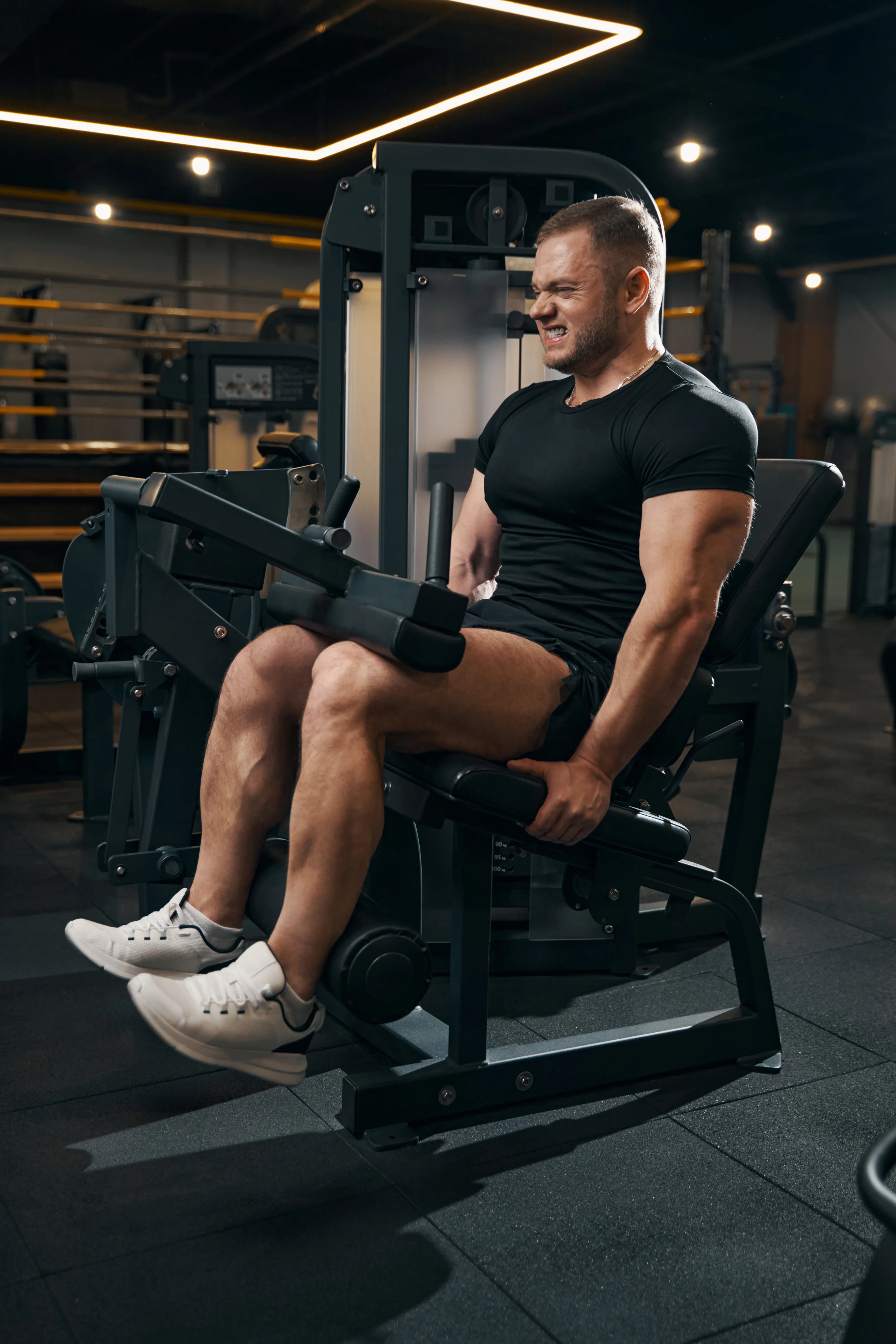
Leg extension: recline the backrest as far as possible |
2 × 8–12 |
Quads |
|
Single-leg calf raise: stand on one foot on a step or platform, keep the working leg straight, and use a full range of motion |
3 × 12–15/leg |
Calves |
Keep in mind that any leg day workout routine is a compromise: it can't account for how well you recover, which exercises you respond to best, which areas you want to prioritize, or how much training volume is right for you. AITOFIT builds your leg workout around your training data, adjusting exercise selection, set volume, and progression as you improve.
Do Home Leg Workouts Actually Work?
Short answer: Yes. A bodyweight leg workout can build muscle as long as the exercises are challenging enough and your sets are taken close to failure. The basic requirements for muscle growth are the same at home as they are in the gym.
Your muscles do not know whether the load comes from a barbell, a resistance band, a backpack, or your body weight. They respond to a training stimulus when sets are taken close enough to failure. At home, the challenge is getting enough load, and there are two main solutions: single-leg exercises, which effectively increase the relative load on the working leg, and longer sets taken closer to failure. Bodyweight leg exercises and resistance band leg workouts can both be useful here. As a bonus, unilateral lower body exercises can also help address side-to-side muscle imbalances. That said, over the long term, leg workouts are usually more effective in a gym if you have access to one, because adding load is more practical and you have more exercise options.
|
Exercise |
Sets × Reps |
Target Muscles |
|---|---|---|
|
Bulgarian split squat (backpack or dumbbells) |
3 × 8–15/leg |
Quads, glutes |
|
Reverse lunge |
3 × 10–15/leg |
Quads, glutes |
|
Single-leg hip thrust |
3 × 10–15/leg |
Glutes, hamstrings |
|
Towel leg curl (towel on a smooth floor) |
3 × 5–12 |
Hamstrings |
|
Single-leg calf raise on a step |
3 × 7–20/leg |
Calves |
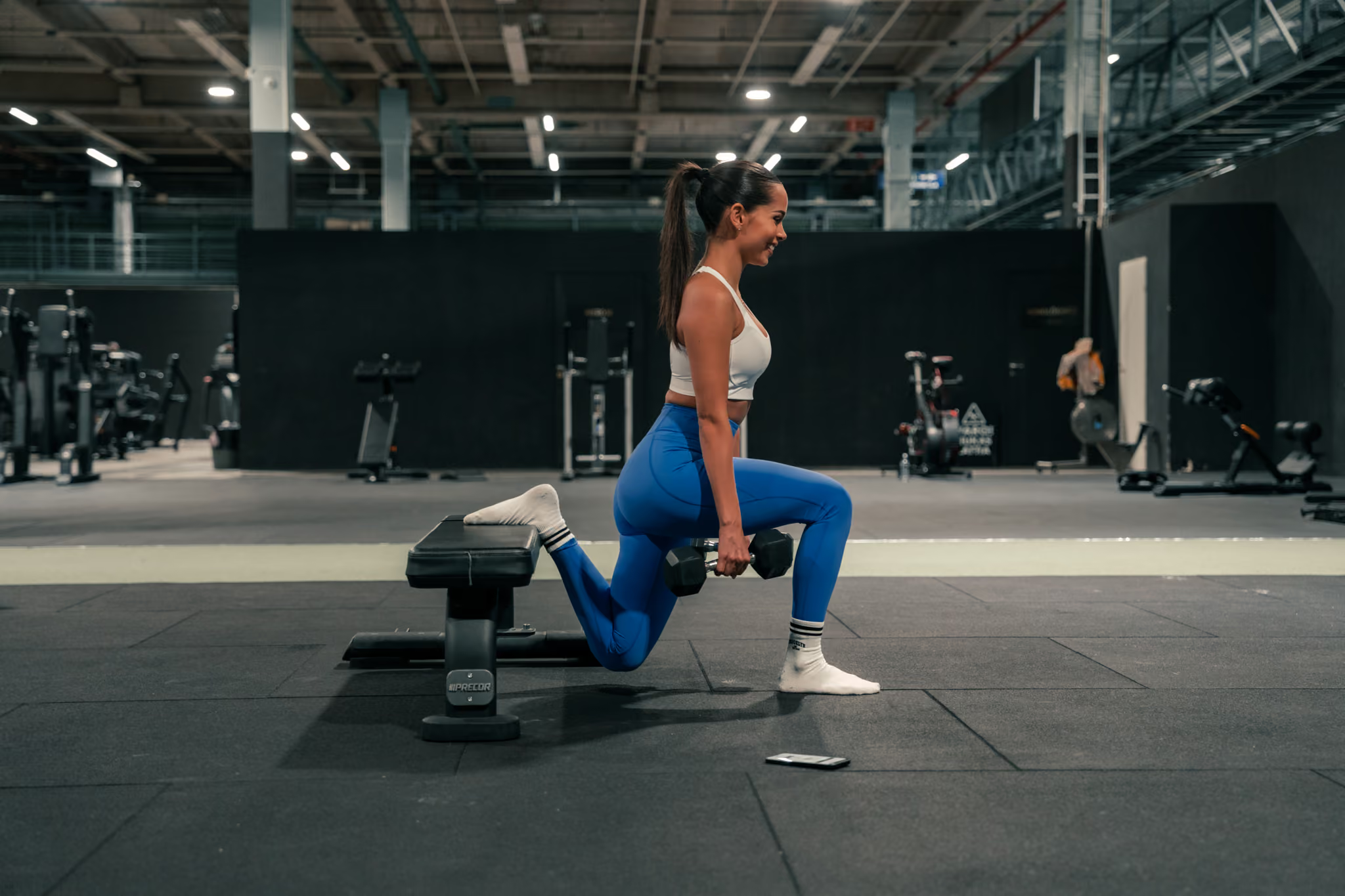
Progression at home can follow three steps: first, add reps to bodyweight squats and other bodyweight leg exercises; then progress from bilateral to single-leg variations; and finally, add external load – a backpack filled with water bottles and books works well. Walking lunges and lateral lunges are also practical lower body exercises when space allows. With walking lunges, step forward with the left leg and plant the left foot flat as the back knee lowers under control. Step through with the right leg, then repeat on the other leg while keeping the front leg stable and your torso upright. That said, training the rectus femoris and the hamstrings at long muscle lengths is harder to replicate at home, so the gym does offer a more complete stimulus for legs. For a full comparison, see our article on home workout vs. gym.
Most Common Leg Workout Mistakes
-
Over-relying on squats. The rectus femoris and hamstrings receive no growth stimulus, no matter how hard the workout feels.
-
Training hamstrings with just one exercise. Doing only curls leaves hip extension untrained, while doing only deadlift variations leaves knee flexion untrained – either way, hamstring development will be incomplete.
-
Only doing seated calf raises. The gastrocnemius – which makes up much of the calf's bulk – effectively grows only with straight-knee exercises.
-
Cutting the range of motion short. Half squats, short extensions, and bounced calf raises all cut out the stretched phase where much of the growth stimulus occurs.
-
Cramming the entire week's volume into one session. Beyond about 15 sets, the quality of the remaining sets drops significantly because of fatigue. The same set count spread across two sessions is more manageable and often more effective.
Frequently Asked Questions About Leg Workouts
How often should I train legs?
1–3 times per week. Total weekly set volume drives growth, and for most people, two sessions per week is the best way to distribute it.
Can I do a leg workout at home without equipment?
Yes, especially during the first few months. Single-leg exercises and sets taken close to failure provide enough stimulus for growth until bodyweight alone becomes too light – at that point, a weighted backpack gives you room to keep progressing.
Why won't my legs grow even though I train them?
The most common reasons are that your exercise selection doesn't cover all the leg muscles (the rectus femoris and hamstrings are the ones most often missed), your sets stop too far from failure, your volume isn't right for you, or the weights aren't increasing over time. Consistent progression is essential for building muscle mass and leg strength.
Squat vs. leg press – which is better for muscle growth?
Both effectively grow the vasti, glutes, and adductors (Kinoshita et al. 2026). Choose whichever allows you to use a deep range of motion and progressively add weight – or use both across different sessions. When it comes to the glutes specifically, depth is the deciding factor: a deep squat stretches the glutes more than most leg press setups, making the squat a natural first choice for glute-focused training. See our glute workout guide for more.
Is a leg workout different for women?
No. The principles of muscle growth are the same regardless of sex, and several of the studies cited in this article were conducted exclusively with women. Whether your goal is to build strong legs, add muscle mass, improve leg strength or muscle definition, or achieve the look often described as toned legs, differences in programming come from individual goals, muscle priorities, and starting level.
Does leg training boost testosterone and make the whole body grow?
No. This is a persistent myth. Heavy leg training does cause short-term hormonal spikes, but these acute fluctuations don't predict muscle growth (Morton et al. 2016). These acute hormonal changes are related to energy metabolism after intense exercise, not directly to muscle building. Leg training builds muscle and strength in the legs. It does not meaningfully raise testosterone or cause other muscles to grow.
Are deep squats bad for your knees?
Not for healthy knees, as long as load is added gradually and technique is solid. Joint structures adapt to load just as muscles do. Greater depth is especially beneficial for the glutes and adductors.
How many exercises should a leg workout have?
Four to six well-chosen leg exercises can cover the entire lower body and train multiple muscle groups efficiently.
Can I train legs while they're still sore?
Mild to moderate soreness does not prevent you from training. However, if your legs are still clearly sore, it is usually worth allowing more time to recover. Persistent soreness may also signal that the program's frequency or volume needs adjusting.
Happy training!
References: Kubo K, Ikebukuro T, Yata H. (2019). Effects of squat training with different depths on lower limb muscle volumes. European Journal of Applied Physiology 119:1933–1942. Kassiano W, Costa B, Kunevaliki G, et al. (2026). Comparison of Muscle Hypertrophy and Strength Adaptations Induced by Back Squat and Leg Extension Resistance Exercises. Journal of Strength and Conditioning Research 40(4):367–376. Kinoshita M, Maeo S, Kobayashi Y, et al. (2026). Hypertrophic Effects of Single- versus Multi-Joint Exercise: A Direct Comparison between Knee Extension and Leg Press. Medicine & Science in Sports & Exercise, published online Feb 5, 2026. Maeo S, Huang M, Wu Y, et al. (2021). Greater Hamstrings Muscle Hypertrophy but Similar Damage Protection after Training at Long versus Short Muscle Lengths. Medicine & Science in Sports & Exercise 53(4):825–837. Maeo S, Balshaw TG, Nin DZ, et al. (2024). Hamstrings Hypertrophy Is Specific to the Training Exercise: Nordic Hamstring versus Lengthened State Eccentric Training. Medicine & Science in Sports & Exercise 56(10):1893–1905. Hartmann H, Wirth K, Klusemann M. (2013). Analysis of the Load on the Knee Joint and Vertebral Column with Changes in Squatting Depth and Weight Load. Sports Medicine 43(10):993–1008. Kinoshita M, Maeo S, Kobayashi Y, et al. (2023). Triceps surae muscle hypertrophy is greater after standing versus seated calf-raise training. Frontiers in Physiology 14:1272106. Refalo MC, Helms ER, Robinson ZP, Hamilton DL, Fyfe JJ. (2024). Similar muscle hypertrophy following eight weeks of resistance training to momentary muscular failure or with repetitions-in-reserve in resistance-trained individuals. Journal of Sports Sciences 42(1):85–101. Schoenfeld BJ, Ogborn D, Krieger JW. (2017). Dose-response relationship between weekly resistance training volume and increases in muscle mass: A systematic review and meta-analysis. Journal of Sports Sciences 35(11):1073–1082. Pelland J, et al. (2025). The Resistance Training Dose Response: Meta-Regressions Exploring the Effects of Weekly Volume and Frequency on Muscle Hypertrophy and Strength Gains. Morton RW, Oikawa SY, Wavell CG, et al. (2016). Neither load nor systemic hormones determine resistance training-mediated hypertrophy or strength gains in resistance-trained young men. Journal of Applied Physiology 121(1):129–138.
Author: Julius Granlund, M.Sc. in Exercise Science (Exercise Physiology), University of Jyväskylä | Reviewed by: Tapio Tulenheimo, M.Sc. in Exercise Science (Exercise Physiology), University of Jyväskylä
Individualized and evidence-based personal training made easily accessible to everyone.


